
These events are milestones in their own right, as they signal a change in how companies return value to shareholders.
Why Milestones Matter in Investing
Milestones matter in investing because they provide tangible markers of progress in a journey that is otherwise long-term and often uncertain. They help investors stay engaged and committed by linking the concept of time in the market rather than timing the market to real, observable outcomes, reinforcing the value of staying invested through different cycles rather than reacting to short-term volatility.
Index milestones reflect long-term market growth, dividend milestones reward consistent profitability and cash returns, stock split milestones signal strong share price growth and improved accessibility, and share buyback milestones reflect confidence in the business while enhancing shareholder value over time.
Purpose of the #InvestorMilestoneChallenge
The purpose of the Investor Milestone Challenge is to encourage better long-term investment behaviour by shifting focus away from reacting to short-term market movements and toward consistent participation in the market.
Will YOU be among the shareholders who receive the shares via stock split, first cash dividend from a company that has never paid one before, or part of the investors who benefit from markets reaching new record highs?
What can you invest in as part of the challenge?
This is a self-directed journey. No one is tracking your progress but you. The reward may be both educational and financial: developing discipline, patience, and a long-term perspective that aligns with how wealth is actually built in markets over time. While the behavioural gains shape how you invest, the financial reward comes from consistently applying those principles - allowing compounding, time in the market, and informed decision-making to translate into real, tangible growth.
As part of the Investor Milestone Challenge, investors can invest R100 (or any amount but commit with self to be consistent) per month and choose to invest in any of the following:
Exchange Traded Funds (ETFs): ETFs are investment products that track a group of companies, focused on an index. This means that instead of buying a single share, you are investing in a basket of companies that represent a broader market, such as the S&P 500 or the FTSE/JSE All Share Index.
ETFs allow investors to gain diversified exposure and participate in overall market growth in a simple, cost-effective way.
Large-cap companies that influence the market. These are the biggest and most established companies in the market. Because of their size, they often have a significant impact on how major indices move.
Investing in large-cap stocks means you are indirectly participating in the performance of the companies that could help drive index milestones and overall market direction.
Index milestones: When tracking an index, milestones are typically measured in round-number increases, often in increments of 1,000 points or more. For example, if an index is trading at 10,000 points, the next milestone would be 11,000 points. Similarly, if it reaches 15,000, the next key milestone would be 16,000. These milestones help investors gauge overall market progress and long-term growth trends, rather than focusing on short-term fluctuations.
Another option is investing in companies that have not yet started returning cash to shareholders through dividends or buybacks, but are expected to do so in the future. These milestones can be significant, as they often reflect a company’s transition into a more mature stage of growth and shareholder returns. This includes businesses that may initiate their first dividend or begin a share buyback programme over time.
Dividends payout such as special dividend and increased payouts could also mark as a milestone especially when it's from operating profits.
To participate in potential stock split milestones specifically, investors often look toward companies whose share prices have grown strongly over time, often driven by consistent earnings growth, market leadership, and strong investor demand. These companies are typically among the leading businesses in their respective markets and sectors.
As share prices rise significantly, they can become less accessible to smaller investors. In response, companies may implement a stock split to reduce the price per share while increasing the number of shares in issue, making them more affordable and liquid in the market.
Part of the Investor Milestone Challenge, you can download the Investor Milestone Participation Sheet, which serves as your personal tracker and reflection tool throughout the journey. The sheet includes examples of milestones and simple steps on how to complete it: record your investment (such as an ETF, large-cap stock, or dividend/buyback opportunity), set your target milestone, and track when it is reached.
As each milestone is achieved, you build a record of your progress over time. Once you’ve completed your milestones, you can frame your participation sheet as a personal achievement and share your story with loved ones or on social media, reflecting on how you stayed consistent and reached your investing goals.
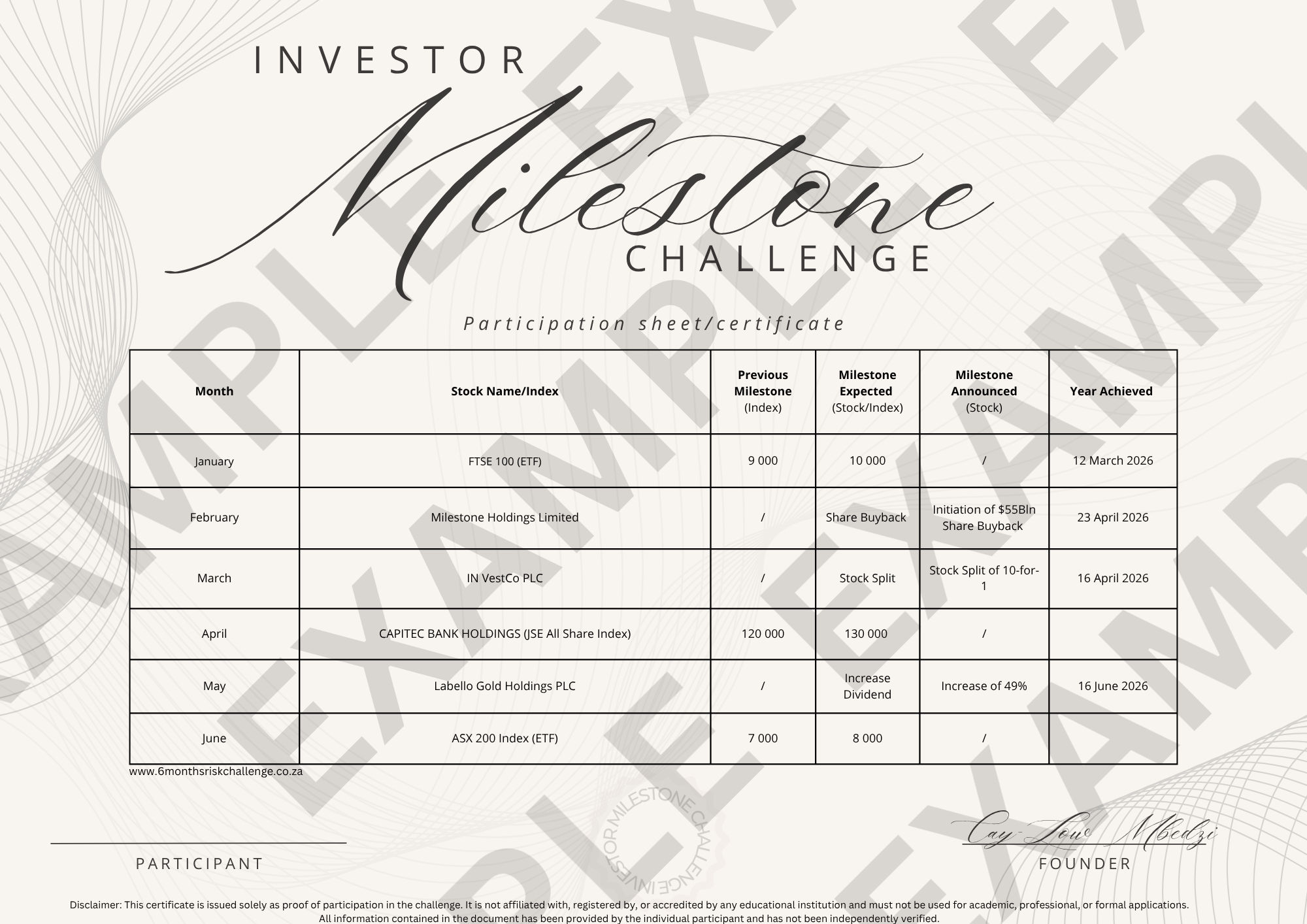
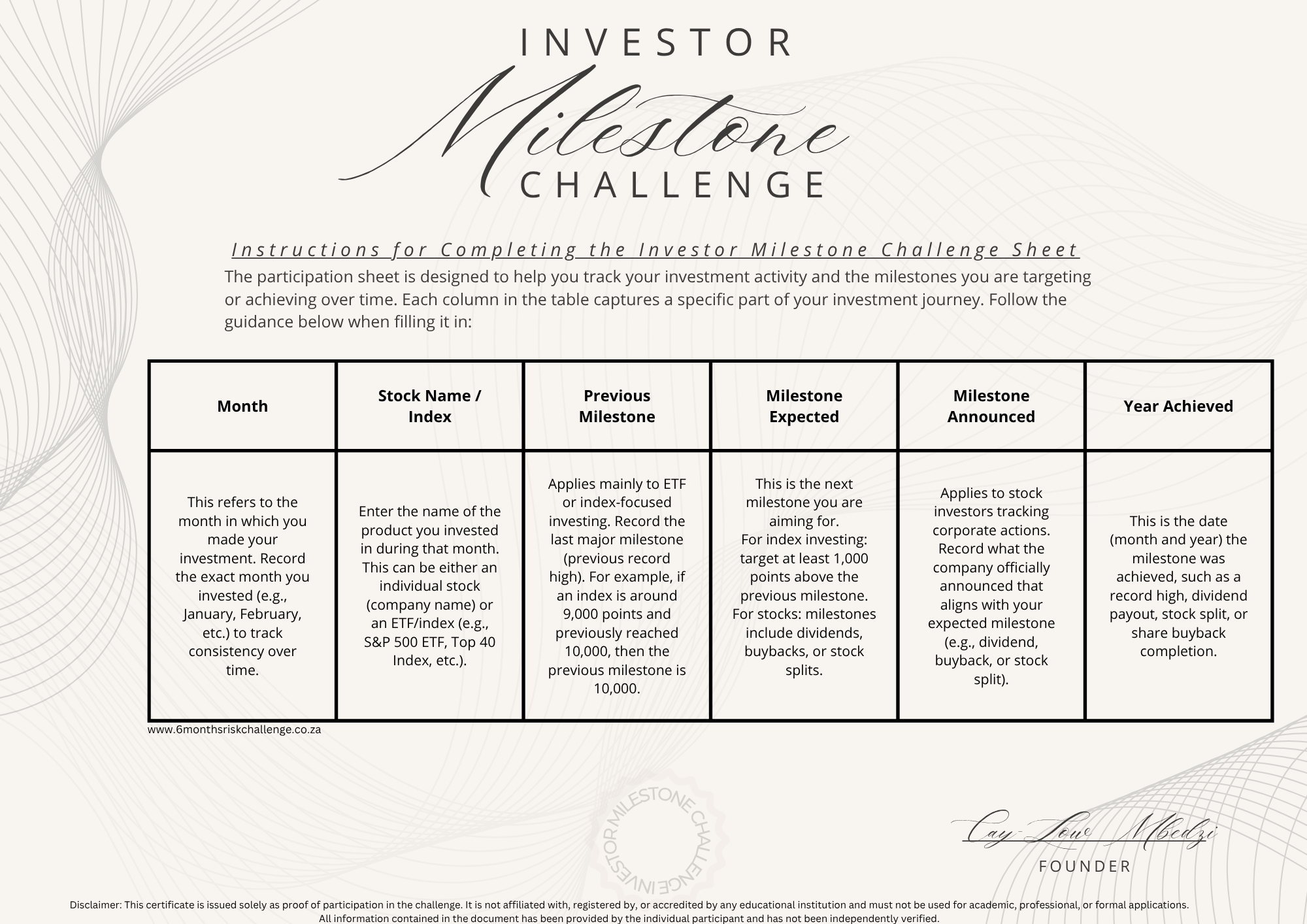

The Investor Milestone Challenge aligns closely with the philosophy behind the 6 Months Risk Challenge, in that both emphasise understanding and managing risk while building disciplined investment behaviour over time. At its core, risk is the uncertainty of outcomes in financial markets - there are no guarantees, only probabilities of gain or loss. Together, this reinforces the principle: investing is not about avoiding risk entirely, but about understanding it, managing it, and consistently showing up despite it.
→ Local ETFs that provide exposure to offshore indices may be impacted by currency movements. A weakening or strengthening of the rand against foreign currencies can influence returns, independent of the underlying index performance.
→ The performance of an index is not dependent on a single stock. It is driven by the combined performance of all its underlying components, which collectively determine the overall direction of the index.
→ The indices and stocks mentioned above do not constitute financial advice or a recommendation to invest in them. There are many other indices and stocks available beyond those referenced.
→ The information provided is for educational purposes only and past performance does not guarantee future returns.
→ Stock splits are not guaranteed and are corporate actions that depend on a company’s decision and market conditions. They do not change the underlying value of an investment and should not be interpreted as an indicator of future performance.